Friday, March 20, 2009

Pictures from Family Fun Night

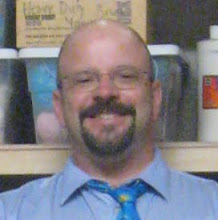
"Everybody say 'Barnacles!'" On Friday, March 13, we had our Family Fun Night & Art Show. I think it's neat to have one of these once a year, because unlike a regular art show, kids can also make something and do some other fun learning activities with their parents -- plus every kid gets to show off to their parents what they are learning in art class and other classes. In the picture above you see me, the Sponge-Bob sculpture we made, my son David in the Sponge-Bob costume (from Costume Capers, and a lot of the kids who came.


Our theme this year was "Oceans of Fun", so all of the art on display was related to that theme, and all the activities had an ocean flavor. In the cafeteria, we had Swedish fish candy and goldfish crackers and ocean blue Kool-Aid.


That Mr. Manchester loves to use that megaphone! In the library, he and Mr. Macik organized a game of Bingo. Lots of neat prizes were won, like comic books and Sponge-Bob posters of historic value.

Kids made Fancy Fish crafts with paper plates and neato foam stickers. Thank you, all you teachers and older kids who helped!


Other events included:


  • Crabby Patty Toss. Mr. Gorman and Mrs. Fisher helped kids with this bean bag throwing game.

  • tours of the inside of a whale, thanks to Mrs. White and her students who organized that.

  • a really neat craft called Porthole Pictures. This is made with two paper plates and blue cellophane. When you look at them, it's as if you're looking out the window of a submarine. This was organized by Miss Bean and Mrs. Shangraw and their helpers. About 140 kids got to make this craft.


If anybody has any pictures from this night, please send them! Our school camera was locked up that night and I couldn't get to it! (Thanks, Mrs. Rowe for sending these).


Wednesday, March 18, 2009

Drawing Light & Shadow

How do artists like James Gurney make paintings that are so realistic? Well, it's a lot of work! One approach Mr. Gurney uses is the making of macquettes. These are little sculptures that he makes. He then sets them up in the studio with a single light source.


If there is a fire on Dinotopia, how do they put it out? There isn't modern technology like fire trucks. To answer that question, Mr. Gurney made the painting below.


Before he began this painting, though he made lots of macquettes, models and sketches. He discussed his ideas with an engineer who designs firetrucks. The macquettes he created below were to help him make paintings of Dinotopian fire fighting equipment.

He changed some details when he painted the scene, but the models he built and the figures helped him imagine the scene.

He made the cab on the dinosaur below out of old mat board and hot glue.

We're not building our own models, but we are using dinosaur toys and action figures to imagine scenes. Below you see that Cyclops of the X-Men is taped to a dinosaur. We're working with the lights off, using only the lights that come in from the skylights. In my demonstration sketch, I'm showing the kids how to use charcoal, blending stump and erasers to create shadows and highlights on objects.

Tyler (below) is doing well on an anklyosaurus drawing.

Shaylee's drawing is below. It's not finished, but you can see that she's got the idea.


To see the whole process of how Mr. Gurney made the fire engine paintings, visit The Gurney Journey.

Thursday, March 12, 2009

Artist Visit Coming Soon!


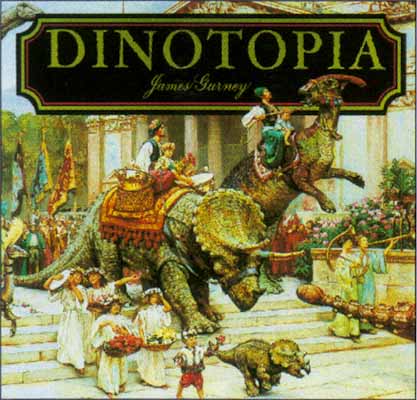
Our school is very lucky in that on April 2, we will be having a special guest. Artist and author James Gurney will be coming to talk to the students about his work. Gurney is a world reknowned artist and illustrator who is best known for his illustrated book series Dinotopia, which is presented in the form of a 19th century explorer's journal from an island utopia where dinosaurs and humans peacefully co-exist.


I think Gurney's work is a good example of how our school subject areas all run together in the real world. He is an artist and a writer, but he also does an amazing amount of research in the fields of science and anthropology to make his fantasy work "believable". He has degrees in anthropology and fine art, but he is also "self-taught" in many areas. He stays up to date on new discoveries about dinosaurs so that his paintings are as authentic as possible.

Gurney's interest in paleontology and anthropology began in his childhood sandbox. As he says on his blog,

When I was in second grade, I was convinced that if I dug enough in my
front yard I'd find the tomb of an Egyptian pharaoh or the skull of a T. Rex.
Never mind that I grew up in Santa Clara County, California, the heart of
suburbia. You can't talk a determined archaeologist out of his steely
determination. My dad couldn't talk me out of it either.

I was the youngest of five kids, and by the time I came along, my dad had
pretty much given up on yard maintenance. He didn't mind too much if I dug test
pits in the yard. The Tonka trucks stayed at it for months. All the neighborhood
kids helped out. Eventually their moms banned them from coming over because they came home with their shoes and their pockets full of dirt."


When I heard this story, it made me think of so many of the kids in our school who have what I call "healthy obsessions". Who knows what careers these interests may lead them to? As Gurney says, "Big dreams are born in little people, and I am always grateful to my school teachers, my parents and my older brothers and sisters for encouraging me--and letting me dig up the yard. "

Tuesday, March 10, 2009

Family Fun Night this Friday!


Our Family Fun Night and Art Show is this Friday, March 13. 6:30-8:00. This is open to children who attend Lynch-Bustin Elementary School and their families. There will be crafts, snacks, games and learning fun. As always, these events are free, but we are asking for a $1 donation to help defray expenses.

Lesson Plans -- Week 19

Kindergarten/First Grade
Use basic shapes to draw dinosaurs.
913A. Know and use the elements and principles of each art form to create works in the arts and humanities.


Second Grade.
Artist study: James Gurney. Discuss and make drawings inspired by his books.
913A. Know and use the elements and principles of each art form to create works in the arts and humanities.

Third Grade. Review concepts from video last week. Finish still life drawings.
Genre: A type or category (e.g., music - opera, oratorio; theater - tragedy, comedy; dance - modern, ballet; visual arts- pastoral, scenes of everyday life).
913A. Recognize critical processes used in the examination of works in the arts and humanities. Compare and contrast
913F. Know how to recognize and identify similar and different characteristics among works in the arts

Fourth Grade.
Artist study: James Gurney.
Art history video. Landscapes. Continue work on landscape drawings. Add dinosaurs to create a human/dinosaur society.
913A. Recognize critical processes used in the examination of works in the arts and humanities. Compare and contrast
913F. Know how to recognize and identify similar and different characteristics among works in the arts

Fifth Grade.
Most students should be done with inking. If not, they can finish. Those who are finished will clean up any stray pencil marks with an erasers. Then they can use correction fluid to cover and accidental ink spots. They can touch up with either ink pen or markers.
Artist study. James Gurney.
Next unit: Drawing from life. Single light source. Shading with charcoal and blending stump.

913D. Use knowledge of varied styles within each art form through a performance or exhibition of unique work.
915A. Know and use the elements and principles of each art form to create works in the arts and humanities.

Wednesday, February 18, 2009

Lesson Plans -- Week 17

"Design, creativity and empathy -- so-called "right brain" attributes typically associated with the arts -- are among the fundamental qualities the work force of the future needs to master." --
Dan Pink, innovation expert

Kindergarten.
Class one: Read book to children, Tickly Octopus by Ruth Galloway. Drawing lesson.
Class two: Paint drawings with watercolor ink.
913A. Know and use the elements and principles of each art form to create works in the arts and humanities.
First Grade.
Class one: Watercolor paintings. Finish paintings begun last week.
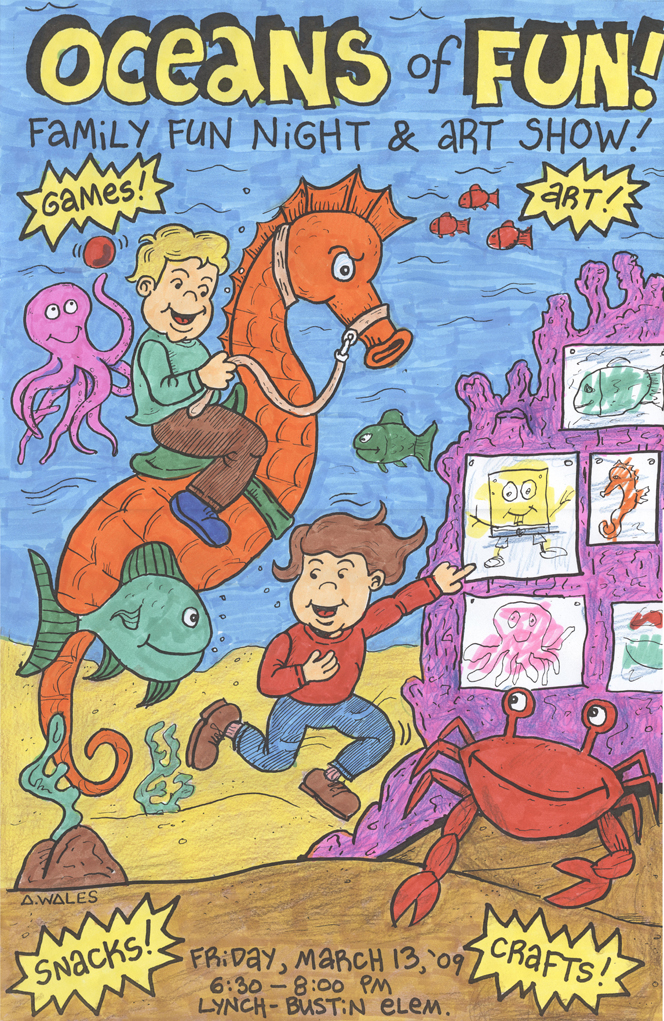
Posters: Design posters advertising family fun night.
913A. Know and use the elements and principles of each art form to create works in the arts and humanities.

Second and Third Grade.
Finish making a poster advertising the next family fun night. Details are on board. They will draw slogan in block letters and color with marker. They can add images to the poster as they desire. Underwater images are available as well as Sponge-bob cartoon books.
Making displays of artwork in hall.
913A. Know and use the elements and principles of each art form to create works in the arts and humanities.

Fourth Grade.
Make displays of artwork in hall.
Being new unit: Landscapes. What are the parts of a landscape: background, middleground, foreground.
913A. Know and use the elements and principles of each art form to create works in the arts and humanities.

Fifth Grade.
Demonstrate steps in the process. Pencil, ink, erase. Students finish today.
Using pen and ink techniques. Procedures. Demonstrate how it is done. Students will practice these techniques in inking the comic strips they have created. Remind the students that they should not place open containers of india ink next to the edge of the table where they can easily be knocked off. One bottle of ink can be shared by two students. Ink is placed on an index card that can be used as a test paper. Remind them that the ink pens need to be held correctly. When looking at it from the top down there is a triangular peak, like the roof of a house. If the pen is held upside down, it will not work correctly. Students will try to finish inking all the lines in the comic strips they’ve drawn. When they are finished they will be placed on the drying rack to dry.
When they are finished, they will help with art show displays, posters, etc.
915A. Know and use the elements and principles of each art form to create works in the arts and humanities.

Monday, February 2, 2009

Lesson PLans -- Week 16

Lesson Plans
Week 16: February 2-6, 9, 10.

“Did you know that young people who participate in the arts for at least three hours, three days a week for a year are: 4 times more likely to be recognized for academic achievement, 3 times more likely to be elected to class office within their schools, and 4 times more likely to participate in a math and science fair?" –americansforthearts.org


Kindergarten.
Colored pencil drawing. Each student will be given a 9x12 piece of white drawing paper. They will follow step by step directions in drawing and animal. They will outline the pencil lines with black marker and color with colored pencil.
913A. Know and use the elements and principles of each art form to create works in the arts and humanities.
First Grade.
Make posters advertising “Oceans of Fun” family fun night. Discuss what makes a good poster- slogans, block letters, legible information, interesting graphics.
913A. Know and use the elements and principles of each art form to create works in the arts and humanities.

Second and Third Grade.
Heinz contest. Discuss rules and directions. Limited flat color- only certain colors can be used. Brainstorm for ideas.
913A. Know and use the elements and principles of each art form to create works in the arts and humanities.

Fourth Grade.
Symmetry. Define. Find examples in nature. Lines of symmetry – one and two. Create symmetrical designs.
913A. Know and use the elements and principles of each art form to create works in the arts and humanities.

Fifth Grade.
Using pen and ink techniques. Procedures. Demonstrate how it is done. Students will practice these techniques in inking the comic strips they have created.
915A. Know and use the elements and principles of each art form to create works in the arts and humanities.